
Sitemap
A list of all the posts and pages found on the site. For you robots out there is an XML version available for digesting as well.
Pages
Posts
Test-Driven Development (TDD): Menulis Tes Sebelum Kode, Masih Relevan?
Published:
Dalam praktik pengembangan perangkat lunak modern, Test-Driven Development (TDD) sering disebut sebagai pendekatan “membalik cara berpikir tradisional”. Alih-alih menulis kode fungsional terlebih dahulu, lalu mengujinya kemudian, TDD justru menekankan menulis tes terlebih dahulu sebelum implementasi kode. Ide utama dari konsep ini adalah agar fitur yang dibangun sesuai dengan requirement yang telah didefinisikan. Namun di tengah tuntutan industri yang serba cepat, muncul pertanyaan: apakah TDD masih relevan dan efisien di era sekarang?
Mengapa Clean Code Bukan Sekadar Gaya Menulis, Tapi Kebutuhan Tim
Published:
Dalam dunia pengembangan perangkat lunak, istilah clean code sering kali muncul, terutama di kalangan developer yang peduli terhadap kualitas kode dan kerja tim jangka panjang. Meski begitu, masih ada anggapan bahwa clean code hanyalah soal gaya penulisan atau suatu hal yang sifatnya opsional dan bisa diabaikan demi mengejar fitur atau deadline. Padahal, clean code bukanlah hanya tentang estetika atau sekadar konvensi, melainkan bagian penting dari keberlangsungan proyek, kolaborasi tim yang efektif, serta pemeliharaan sistem dalam jangka panjang.
Technical Debt: Bahaya Tak Terlihat dalam Proyek Software
Published:
Pada pengembangan perangkat lunak, terdapat suatu istilah yang seharusnya dihindari, tetapi sering muncul, yaitu “technical debt” atau “utang teknis.” Konsep ini mengacu pada keputusan jangka pendek dalam menulis kode atau arsitektur yang tampak efisien untuk saat ini, tetapi keputusan tersebut dapat menimbulkan masalah besar di masa depan. Konsepnya sama seperti utang finansial, technical debt harus “dibayar”, baik dalam bentuk waktu, biaya tambahan, maupun effort atau kompleksitas yang meningkat.
Mengenal Agile, Scrum, dan Kanban: Metodologi Populer dalam Pengembangan Perangkat Lunak
Published:
Dalam dunia pengembangan perangkat lunak modern (Software Engineering), kecepatan, adaptabilitas, dan kolaborasi menjadi kunci utama. Untuk menjawab tantangan tersebut, banyak tim software engineering beralih dari pendekatan konvensional menjadi pendekatan Agile dan menggunakan kerangka kerja seperti Scrum atau Kanban. Namun, ketiganya sering kali disalahpahami dan membingungkan bahkan dianggap sinonim. Padahal, meskipun saling berkaitan, Agile, Scrum, dan Kanban memiliki peran dan struktur yang berbeda. Pada artikel ini kita akan membahas ketiganya secara lebih terstruktur.
GitHub Copilot: Seberapa Efektif AI Membantu Programmer Menulis Kode?
Published:
Dalam beberapa tahun terakhir, teknologi kecerdasan buatan (AI) telah merambah berbagai bidang, termasuk dunia pemrograman itu sendiri. Salah satu inovasi paling menonjol adalah GitHub Copilot, sebuah asisten coding berbasis AI yang dikembangkan oleh GitHub dan OpenAI. Dengan kemampuan untuk menyelesaikan kode secara otomatis, menyarankan baris kode, dan menerjemahkan instruksi natural language ke dalam bahasa pemrograman, Copilot disebut-sebut sebagai “pair programmer” versi digital.
Pertarungan Model AI Raksasa: Grok 4, Claude 4, Gemini 2.5, LLama 4, dan Qwen 3
Published:
Tahun 2025 telah menjadi salah satu momen penting dalam sejarah perkembangan kecerdasan buatan. Setelah bertahun-tahun model AI fokus pada peningkatan kapasitas pemrosesan bahasa dan gambar, kini kita memasuki era baru, yaitu AI yang mampu memahami konteks panjang, melakukan reasoning tingkat lanjut, serta terintegrasi langsung dengan tools atau alat kerja manusia modern. Beberapa raksasa teknologi seperti Google, Meta, xAI, dan Anthropic telah merilis model terbaru yang bukan hanya canggih secara teknis, tapi juga semakin diarahkan untuk bisa benar-benar reliable dalam kehidupan sehari-hari, baik oleh developer, profesional, maupun publik secara umum. Dalam artikel ini, kita akan mambahas lebih dalam beberapa model AI paling mutakhir yang dirilis sepanjang 2025.
Membuat AI Agents Sendiri dengan n8n: Cuma Modal Drag-and-Drop!
Published:
Kita sudah memasuki era yang serba AI (Artificial Intelligence). Hampir seluruh aspek kehidupan saat ini dipengaruhi oleh AI, mulai dari rekomendasi film di aplikasi streaming, chatbot customer service, sistem prediksi cuaca dan keuangan, hingga self-driving car. Namun, di balik kecanggihan itu, banyak yang belum tahu bahwa kita sebenarnya bisa membangun AI Agents kita sendiri dengan cara yang cukup mudah.
Skripsi, Tesis, dan Disertasi: Apa Sih Sebenarnya Perbedaan-nya di Indonesia?
Published:
Buat kamu yang sedang kuliah, atau mungkin sedang mempertimbangkan untuk lanjut ke jenjang pascasarjana pasti sudah tidak asing lagi dengan istilah skripsi, tesis, dan disertasi. Ketiganya merupakan bagian dari proses akademik yang umumnya ditemui dalam sistem pendidikan tinggi di Indonesia.
Langkah Mudah Memulai Riset Sebagai Mahasiswa Bidang Computer Science
Published:
Riset adalah suatu pekerjaan yang pasti akan dialami oleh setiap mahasiswa. Baik itu dalam konteks penelitian mandiri, tugas kuliah, hingga syarat kelulusan seperti skripsi atau publikasi. Memulai riset sebagai mahasiswa di bidang computer science dapat menjadi pengalaman yang menantang namun sangat bermanfaat. Berikut adalah langkah-langkah yang dapat membantu kamu memulai riset kamu dengan lebih terarah.
portfolio
Realtime BISINDO Recognition
Published:
Real-time Indonesian Sign Language (BISINDO) recognition powered by YOLOv11 and deployed with Streamlit. This app runs directly in the browser using WebRTC webcam integration.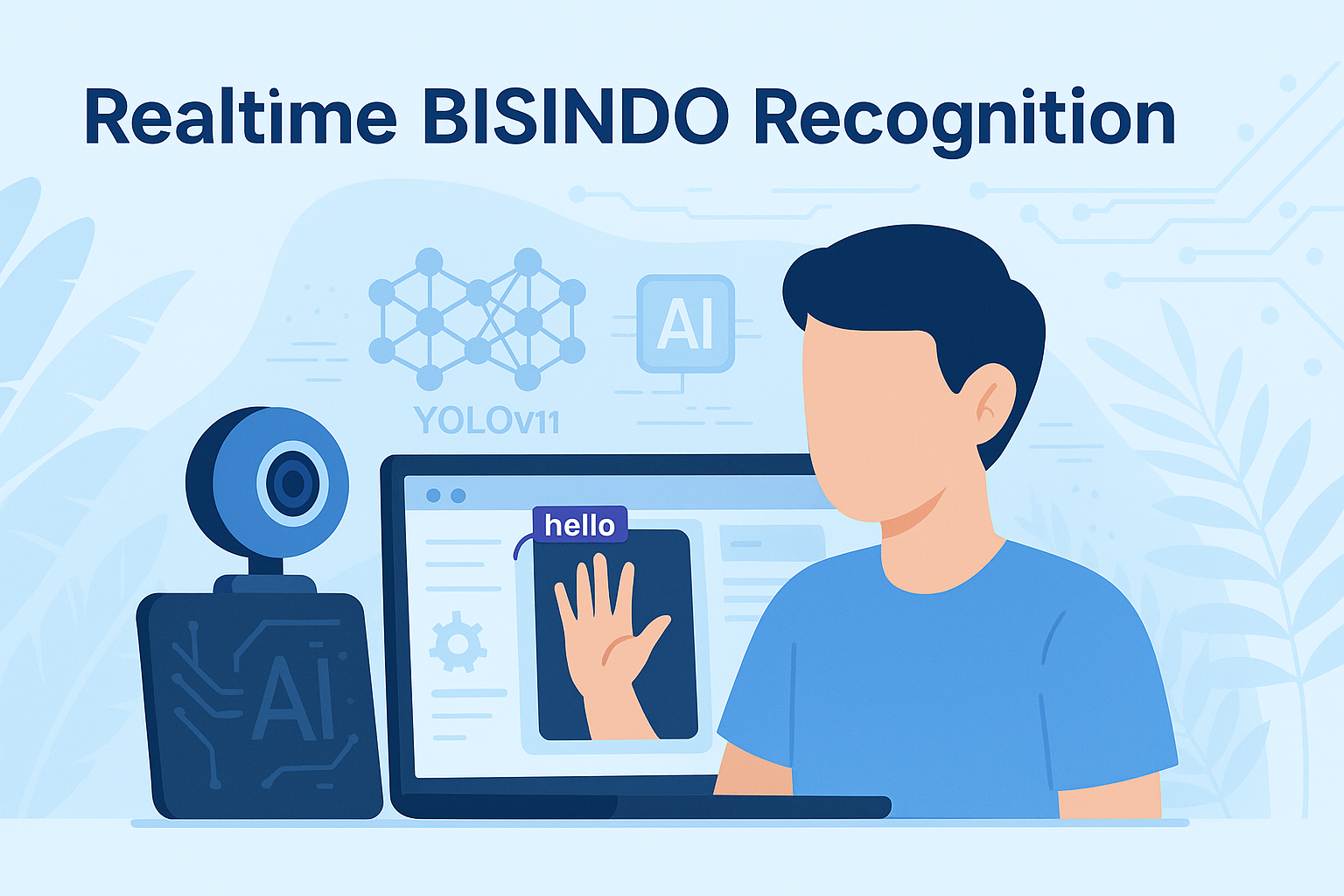
Face Recognition Using Information Retrieval
Published:
A facial recognition system using deep features and FAISS for fast similarity search. Powered by VGG16 embeddings and FAISS indexing for efficient face retrieval.
Sentiment Analysis on Indonesia Presidential Inauguration
Published:
A sentiment analysis project on Indonesian social media during the presidential inauguration period using IndoBERT and tweet scraping.
Kuala Inspirasi Website
Published:
A modern, responsive website for Kuala Inspirasi — a non-profit community focused on social and educational initiatives based in Kuala Tungkal, Jambi.
publications
Peringkas Teks Otomatis Bahasa Indonesia secara Abstraktif Menggunakan Metode Long Short-Term Memory
Published in eProceedings of Engineering, 2021
Salah satu topik dalam bidang Natural Language Processing (NLP) yang cukup menantang adalah peringkas teks otomatis. Dalam praktiknya peringkas teks otomatis terbagi menjadi dua pendekatan, yaitu ekstraktif dan abstraktif. Pendekatan abstraktif dinilai lebih baik karena cara kerjanya mendekati cara kerja manusia ketika meringkas teks atau yang disebut parafrase. Metode yang digunakan pada penelitian ini adalah Long Short-Term Memory (LSTM) yang mana metode tersebut telah sukses melakukan peringkasan dalam Bahasa Inggris. Dataset yang digunakan adalah kumpulan artikel berita media daring Bahasa Indonesia. Hasil terbaik yang didapatkan pada pengujian dengan metode LSTM menggunakan metode evaluasi ROUGE-1 adalah 0.13846. Kata kunci: peringkas teks otomatis, abstraktif, Bahasa Indonesia, long short-term memory, ROUGE Abstract One topic about natural language processing that is quite challenging is automatic text summarization. Automatic-text-summarization is practically divided into two kinds of approach, namely extractive and abstractive. Abstractive-approach is considered better since it resembles how humans work in terms of text summarizing or paraphrasing. A method used in this study is Long Short-Term Memory (LSTM) which has succeeded to summarize texts in English. Datasets that have been used are a number of online news articles in Bahasa Indonesia. The best result gained using LSTM based on the ROUGE-1 evaluation is 0.13846.
Recommended citation: Saputra, M. A., & Al Maki, W. F. (2021). Peringkas Teks Otomatis Bahasa Indonesia secara Abstraktif Menggunakan Metode Long Short-Term Memory. eProceedings of Engineering, 8(2).
Download Paper | Download Slides
Recognizing Indonesian sign language (Bisindo) gesture in complex backgrounds
Published in Indonesian Journal of Electrical Engineering and Computer Science (IJEECS), 2024
Sign language, particularly Indonesian sign language (Bisindo), is vital for deaf individuals, but learning it is challenging. This study aims to develop an automated Bisindo recognition system suitable for diverse backgrounds. Previous research focused on greenscreen backgrounds and struggled with natural or complex backgrounds. To address this problem, the study proposes using Faster region-based convolutional neural networks (RCNN) and YOLOv5 for hand and face detection, MobileNetV2 for feature extraction, and long short-term memory (LSTM) for classification. The system is also designed to focus on computational efficiency. YOLOv5 model achieves the best result with a sentence accuracy (SAcc) of 49.29% and a word error rate (WER) of 16.42%, with a computational time of 0.0188 seconds, surpassing the baseline model. Additionally, the system achieved a SacreBLEU score of 67.77%, demonstrating its effectiveness in Bisindo recognition across various backgrounds. This research improves accessibility for deaf individuals by advancing automated sign language recognition technology.
Recommended citation: Saputra, M. A., & Rakun, E. (2024). Recognizing Indonesian sign language (Bisindo) gesture in complex backgrounds. Indonesian Journal of Electrical Engineering and Computer Science, 36(3), 1583-1593. https://doi.org/10.11591/ijeecs.v36.i3.pp1583-1593
Download Paper | Download Slides
Deep Learning and Explainable AI for Accurate and Interpretable Software Defect Prediction
Published in The 2024 International Conference on Data Engineering and Enterprise System (ICDEES 2024), 2024
Software defect prediction is an essential aspect of software development process as defects significantly impact software reliability and usability. Several methods have been studied to predict the defects in software, but most of the time, the prediction result lack of transparancy about which features actually contributes to the prediction results. In this study, we adopt the Convolutional Neural Network (CNN) model for defect prediction, then apply the Local Interpretable Model-Agnostic Explanations (LIME) to gain interpretability on the prediction result. In order to address the data imbalance issue, we apply the Synthetic Minority Over-sampling Technique (SMOTE). Experiments on the NASA Promise repository datasets (CM1, JM1, KC1, KC2, and PC1) shows that the model achieve accuracy ranging from 81% to 92% across the dataset. Furthermore, through the LIME analysis, some metrics such as Lines of Code (LoC) and Effort (e) give more substantial influence in the defect predictions.
Recommended citation: Saputra, M. A., Lumban Gaol, F., Soeparno, H., & Arifin, Y. (2024). Deep learning and explainable AI for accurate and interpretable software defect prediction. In Proceedings of The 2024 International Conference on Data Engineering and Enterprise System (The ICDEES 2024). Yogyakarta, Indonesia, November 29-30, 2024.
Download Paper | Download Slides
Online Gambling Promotion Detection in Indonesian YouTube Comments Using Semi-Supervised IndoBERT Classification
Published in The 10th International Conference on Computer Science and Computational Intelligence (ICCSCI), 2025
The widespread promotion of online gambling through user-generated content on social media platforms has raised significant concerns, especially in regions with high internet penetration such as Indonesia. This research proposes a classification-based approach to detect online gambling promotional content in Indonesian-language YouTube comments using a semi-supervised learning strategy. A total of 10,101 comments were collected, of which 10% were manually labeled as either Promotion or Non-Promotion. Initial training using only the labeled data employed IndoBERT, a pre-trained language model for Bahasa Indonesia, which achieved an accuracy of 0.953, precision of 0.945, recall of 0.977, and F1-score of 0.961. Although the baseline performance was strong, the IndoBERT model was slightly outperformed by the SVM classifier. To address the limitations of labeled data, pseudo-labeling was applied to the remaining unlabeled data, which was then combined with the labeled subset to retrain the IndoBERT model. The evaluation results showed a significant improvement in classification performance after semi-supervised training, achieving an accuracy of 0.986, precision of 0.991, recall of 0.980, and F1-score of 0.985, surpassing all previously tested models. These findings highlight the effectiveness of IndoBERT in understanding informal online language and the advantage of semi-supervised learning in resource-constrained annotation scenarios.
Recommended citation: Santika, S. P., Saputra, M. A., Zahra, A., & Suhartono, D. (2025). Online Gambling Promotion Detection in Indonesian YouTube Comments Using Semi-Supervised IndoBERT Classification. Procedia Computer Science, 269, 1269-1278.
Download Paper | Download Slides
Oil Palm Condition Monitoring via UAV Imagery Using YOLOv11 Enhanced for Class Imbalance
Published in 2025 17th International Conference on Information Technology and Electrical Engineering (ICITEE), 2025
Effective monitoring of oil palm tree conditions is crucial for advancing precision agriculture. Previous studies have primarily focused on detecting and counting oil palm trees, but such approaches are insufficient without the ability to assess tree health. This study proposes a modified YOLOv11 model for oil palm condition detection using the MOPAD dataset, which includes five condition classes. The modification enhances the loss function by introducing class weighting based on data distribution, applying weighted Focal Loss to mitigate the dominance of easy negatives, employing SmoothL1 Loss for more stable bounding box regression, and approximating Distribution Focal Loss (DFL) for distance distribution prediction. Experimental results demonstrate that the proposed model outperforms baseline methods-YOLOv8, Deformable DETR, and standard YOLOv11-achieving superior performance with a precision of 99.80%, recall of 99.47%, and F1-score of 99.64%. Visual analysis of inference outputs further confirms that the modified YOLOv11 delivers more consistent condition detection and closer alignment with ground truth, validating the effectiveness of the loss rebalancing strategy in addressing class imbalance for UAV-based oil palm monitoring.
Recommended citation: Saputra, M. A., Soeparno, H., Arifin, Y., & Budiharto, W. (2025, October). Oil Palm Condition Monitoring via UAV Imagery Using YOLOv11 Enhanced for Class Imbalance. In 2025 17th International Conference on Information Technology and Electrical Engineering (ICITEE) (pp. 1-6). IEEE.
Download Paper | Download Slides
Evaluating the Adversarial Vulnerability of YOLOv11 for Indonesian Sign Language (BISINDO) Recognition
Published in 2025 8th International Conference on Informatics and Computational Sciences (ICICoS), 2025
Indonesian Sign Language (BISINDO) is a common form of communication used by the deaf community in Indonesia. Various deep learning models have been successfully utilized to recognize BISINDO gestures, including object detection models such as YOLO. However, these models remain vulnerable to adversarial attacks. This study aims to evaluate the robustness of the YOLOv11 model against three types of adversarial attacks, namely the Fast Gradient Sign Method (FGSM), Projected Gradient Descent (PGD), and Basic Iterative Method (BIM). We utilize the BISINDO sign image dataset, which consists of 26 alphabet gesture classes (A to Z). The YOLOv11 model achieved a baseline performance of 0.945 mAP on clean data. The model was tested on adversarial images, and the results show a significant mAP drop of 49% under PGD and BIM attacks. In contrast, FGSM only reduces mAP by about 13%. This study provides an initial foundation for further research on model robustness and strength against adversarial attacks in the context of sign language recognition. Furthermore, the findings highlight the importance of developing robust BISINDO recognition systems to ensure reliable communication accessibility in real-world applications.
Recommended citation: Saputra, M. A., Heryadi, Y., Sonata, I., Wulandhari, L. A., & Girsang, A. S. (2025, October). Evaluating the Adversarial Vulnerability of YOLOv11 for Indonesian Sign Language (BISINDO) Recognition. In 2025 8th International Conference on Informatics and Computational Sciences (ICICoS) (pp. 241-246). IEEE.
Download Paper | Download Slides
talks
Deep Learning and Explainable AI for Accurate and Interpretable Software Defect Prediction
Published:
I had the opportunity to attend and present my research paper, “Deep Learning and Explainable AI for Accurate and Interpretable Software Defect Prediction”, at the 2024 International Conference on Data Engineering and Enterprise Systems (ICDEES), held in Yogyakarta on November 29-30, 2024.
Oil Palm Condition Monitoring via UAV Imagery Using YOLOv11 Enhanced for Class Imbalance
Published:
I had the opportunity to attend and present my research paper, “Oil Palm Condition Monitoring via UAV Imagery Using YOLOv11 Enhanced for Class Imbalance,” at the 17th International Conference on Information Technology and Electrical Engineering (ICITEE 2025), held in Bangkok, Thailand, on October 20, 2025.
Evaluating the Adversarial Vulnerability of YOLOv11 for Indonesian Sign Language (BISINDO) Recognition
Published:
I had the opportunity to present my research paper, “Evaluating the Adversarial Vulnerability of YOLOv11 for Indonesian Sign Language (BISINDO) Recognition,” at the 8th International Conference on Informatics and Computational Sciences (ICICoS 2025), held on October 29, 2025, in Semarang, Thailand.
teaching
Agile Software Development 2024/2025
Undergraduate course, BINUS University, School of Computer Science, 2025
| COMP6884001 - Agile Software Development | This course provides a comprehensive exploration of essential topics in the field, equipping students with the knowledge and skills needed for embarking on a transformative journey in the world of Agile Software Development. This course provides an in-depth exploration of Agile principles, methodologies, technical, cultural, and social aspects. Through a combination of theoretical discourse and immersive experiential learning, especially in technical skills, students will acquire the discerning skills necessary to excel in the sophisticated landscape of Agile project management. |
Software Engineering 2024/2025
Undergraduate course, BINUS University, School of Computer Science, 2025
| COMP6100001 - Software Engineering | This course provides a comprehensive examination of the principles, methodologies, and tools necessary for the structured development, deployment, and maintenance of high-quality software systems. Aimed at aspiring software engineers, it connects theoretical foundations with practical applications, equipping students to address real-world challenges in the software industry. The course is relevant to Object-Oriented Software Engineering and Advanced Topics in Software Engineering. |
Algorithm and Programming 2025/2026
Undergraduate course, BINUS University, School of Computer Science, 2025
| COMP6047001 - Algorithm and Programming | This course comprises the fundamental concepts of algorithms and programming using the C programming language. Students will learn basic algorithmic thinking, problem-solving strategies, and core programming principles such as variables, control structures, functions, arrays, pointers, and file handling. By completing this course, students will have programming foundation using C and able to develop program using C. This course serves as a prerequisite for the Data Structures course. |
Tutorial PHP & MySQL - SMA Saint John
High School Extracurricular, Saint John's Catholic School, 2026
| Tutorial Web Design – SMA Saint John | This tutorial introduces high school students to the basics of web development using PHP and MySQL. Students learn how dynamic websites store and manage data through simple CRUD (Create, Read, Update, Delete) operations. Through hands-on practice, students build a basic database-driven web application and gain an introductory understanding of backend and web development fundamentals. |
Software Engineering 2025/2026
Undergraduate course, BINUS University, School of Computer Science, 2026
| COMP6100001 - Software Engineering | This course provides a comprehensive examination of the principles, methodologies, and tools necessary for the structured development, deployment, and maintenance of high-quality software systems. Aimed at aspiring software engineers, it connects theoretical foundations with practical applications, equipping students to address real-world challenges in the software industry. The course is relevant to Object-Oriented Software Engineering and Advanced Topics in Software Engineering. |
Software Architecture Patterns – Study Guide
Study Guide, BINUS University, 2026